


You know that feeling when you walk into a bakery, order a fresh croissant, sit down at a table (with plenty of napkins!), and carefully tear it in half? The way those flakey layers crumble in buttery deliciousness? Yeah. That’s not what’s supposed to happen when you pet your dog.
If you’re finding flakes flying during a snuggle session, your dog’s dry skin may seem like the obvious culprit, but allergies, parasites, infections, and even hormonal conditions can cause many of the same symptoms.
Dry skin on dogs can range from mild seasonal dandruff to a sign of allergies, parasites, infection, or chronic skin disease. Many mild cases improve with grooming, omega-3 supplements, and a humidifier, but persistent flakes, scabs, hair loss, redness, or odor usually mean it’s time for a veterinary exam.

What Causes Dry Skin on Dogs?
Dry skin is a symptom, not a diagnosis. The same flaky coat can come from many triggers, and treatment depends on the cause.
Environmental and grooming factors. Heated air in winter often drops humidity below 30 percent, drying the skin barrier. Frequent bathing, harsh shampoos, and human hair products strip protective oils.
Parasites. Parasites are one of the most overlooked causes of dandruff, itching, hair loss, and crusty skin in dogs.
Fleas: Per the American Kennel Club, the most common skin disorder in US dogs is flea allergy dermatitis, which can cause intense itching, redness, scabs, and flaky skin, especially near the tail base.
Cheyletiella mites: If the "dandruff" appears to be moving on its own, it isn't dandruff. The Western College of Veterinary Medicine says that Cheyletiella mites are large enough to see without a microscope and earned the nickname "walking dandruff" because they look like white flakes crawling through the coat. This requires prescription medication treatment.
Demodex mites: Can cause patchy hair loss, scaling, crusting, and secondary skin infections.
Sarcoptes scabiei mites: Also called canine scabies, these mites cause severe itching, redness, and crusty skin lesions.
Allergies. Dogs can react to environmental allergens, food, and contact irritants. Allergies often appear between one and three years of age and may progress to atopic dermatitis, a chronic condition with dry, scaly patches and recurring ear infections.
Bacterial and fungal infections. When dry skin starts looking greasy, crusty, discolored, or unusually smelly, infection may be part of the problem. Bacterial and fungal infections can include:
Malassezia (yeast overgrowth): Often causes greasy skin, brown discharge, redness, itching, and a strong musty or sour odor.
Pyoderma: A bacterial skin infection that can cause pustules, yellow crusts, hair loss, and irritated skin.
Ringworm: A fungal infection that causes circular patches of flaky skin, hair loss, and broken hairs.
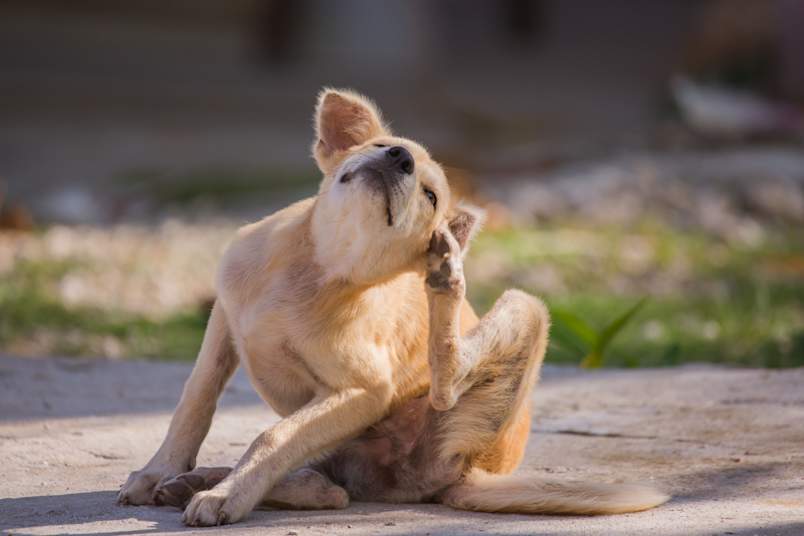
Hormonal disease. According to the Merck Veterinary Manual, hypothyroidism and Cushing's disease both cause dry skin or oily seborrhea, hair loss, and recurring infections. Investigate dry skin in older dogs alongside signs of weight gain, lethargy, or excessive thirst.
Nutritional deficiencies. A diet low in essential fatty acids weakens the skin barrier. Veterinary research has shown that specific types of omega-6 supplementation can improve seborrhea even in dogs on a complete diet.
Dog Dandruff vs. Dry Skin
Dog dandruff and dry skin describe the same problem from different angles. Dandruff is the visible flake; dry skin is the underlying condition.
Veterinarians often use the term Seborrhea to describe abnormal flaking, scaling, or oily skin. Dry seborrhea (seborrhea sicca) usually causes white flakes and a dull coat, while oily seborrhea (seborrhea oleosa) causes greasy scales, odor, and buildup.
Seborrhea can also be primary, meaning inherited in breeds like American Cocker Spaniels and West Highland White Terriers, or secondary, meaning it develops because of another issue like allergies, parasites, infection, or hormonal disease. According to the Merck Veterinary Manual, secondary seborrhea is far more common in dogs.
How to Identify the Type of Flake or Crust
The appearance of your dog's flakes (color, size, texture, location) often points to the cause.
What you see | Likely cause | What to do |
Fine white flakes scattered through coat | Environmental dryness, mild seborrhea, allergies | Try at-home care; see vet if persistent |
Large white flakes that appear to move | Cheyletiella mites (walking dandruff) | See vet for prescription treatment |
Greasy, yellow-tinged scales with odor | Oily seborrhea, often with yeast | See vet for medicated shampoo |
Brown, crusty patches | Yeast (Malassezia) infection | See vet for antifungal treatment |
Yellow crusts with hair loss | Bacterial infection (pyoderma) | See vet; usually needs antibiotics |
Dry crusts and scabs from scratching | Underlying allergy or parasite | See vet to treat the trigger |
Black, gritty specks (often near tail) | Flea dirt | Start parasite prevention |

Where Dry Skin Shows Up
Body area | Most common causes |
Back, near the tail base | Flea allergy dermatitis, dandruff, primary seborrhea |
Belly and groin | Allergies, yeast infection |
Paws and between the toes | Allergies, yeast, contact irritation |
Armpits | Allergies, yeast, fold dermatitis |
Ears and ear margins | Ear margin seborrhea (common in Dachshunds), yeast, allergies |
Face and muzzle | Allergies, ringworm, demodectic mange |
Skin folds (Bulldogs, Pugs, Shar-Peis) | Fold dermatitis, bacterial or yeast overgrowth |
Skin folds and armpits in particular are prone to skin fold dermatitis, where trapped moisture creates a breeding ground for bacterial and yeast overgrowth.
Breeds More Prone to Dry Skin
Any dog can develop dry skin, but some breeds are more likely to develop certain skin conditions because of genetics, skin folds, coat type, or how their skin processes nutrients.

Breeds with inherited scaling or seborrhea:
American Cocker Spaniel: Most strongly associated with primary seborrhea.
West Highland White Terrier: Can develop epidermal dysplasia, a rare inherited skin disorder.
Dachshund: More prone to ear margin seborrhea, which causes scaling and crusting around the ears.
Breeds more prone to skin allergies:
Labrador Retriever
German Shepherd
These breeds are more commonly affected by atopic dermatitis, a chronic allergic skin disease.
Breeds with skin folds that trap moisture:
Bulldog
Pug
Shar-Pei
Skin folds can trap heat and moisture, increasing the risk of fold dermatitis, yeast overgrowth, and bacterial infections.
Breeds with unique nutritional or skin barrier issues:
Siberian Husky
These northern breeds can develop zinc-responsive dermatosis, which causes scaling, crusting, and hair loss.
Hairless breeds:
Without a protective coat, hairless breeds may be more prone to dryness, irritation, and sun damage.
When to See the Vet vs. Manage at Home
Mild dandruff in an otherwise healthy dog usually responds to better grooming and a humidifier. Open sores, severe odor, or rapidly progressing hair loss need a vet.
OK to try at home first | Call the vet within a few days | Call the vet now |
Light dandruff, no other symptoms | Persistent flakes after 2 to 3 weeks of home care | Open sores or bleeding from scratching |
Mild seasonal dryness | Worsening redness | Spreading hair loss |
Occasional scratching | New skin or coat odor | Strong, foul skin odor |
Dry patches with no hair loss | Greasy or yellow flakes | Lethargy or appetite loss with skin issues |
Improves within a week of basic care (humidifier, omega-3s) | Recurring ear infections | Sudden behavioral changes |
How to Treat Dry Skin on Dogs
Treating dry skin on dogs starts with finding the underlying cause. Dry, flaky skin can look similar whether it’s caused by allergies, parasites, infection, or an underlying medical condition, so treatment usually begins with a veterinary exam.
Your vet may recommend:
Physical exam: To check the coat, skin texture, odor, distribution of flakes, and any signs of itching, hair loss, or infection.
Skin scraping: To look for mites, including Demodex or Sarcoptes scabiei.
Skin cytology: To identify bacterial infections or Malassezia overgrowth.
Fungal testing: To rule out ringworm.
Bloodwork: To screen for conditions like hypothyroidism or Cushing's syndrome.
Dermatology referral: For chronic, severe, or hard-to-diagnose skin disease.
Treatment may include:
Medicated shampoos: Anti-seborrheic shampoos with sulfur or salicylic acid help lift scales and reduce buildup. Oily skin may require benzoyl peroxide or tar-based shampoos. Most are used every 3 to 5 days at first, with 10 to 15 minutes of contact time.
Prescription medications: Antibiotics treat bacterial infections, antifungals treat yeast or ringworm, and antiparasitic medications target fleas or mites.
Itch relief: Dogs with atopic dermatitis may benefit from prescription options like Apoquel or Cytopoint for longer-term itch control.
Prescription diets: Elimination diets or therapeutic skin-support diets may help diagnose food allergies and support the skin barrier.
Safe At-Home Remedies (and What Not to Use)

Some cases of dry skin on dogs respond well to simple at-home care, but using the wrong products can worsen irritation or damage the skin barrier.
What's safe to try:
Oatmeal baths with colloidal oatmeal shampoo or finely ground plain oats in lukewarm water, soaked for 10 minutes.
Coconut oil for spot treatment. A thin layer of organic, unrefined coconut oil on intact skin. Get vet approval first.
Omega-3 fish oil supplements at a vet-recommended dose for your dog's weight.
Humidifier to maintain 30 to 50 percent indoor humidity.
Dog-formulated, moisturizing shampoo. Hypoallergenic, soap-free, or vet-recommended formulas.
What NOT to put on your dog:
Human lotions: Wrong pH and irritating ingredients.
Human shampoos: Dog skin pH (6.5 to 7.5) differs from human (4.5 to 5.5).
Tea tree oil: Concentrated forms are toxic to dogs.
Hydrogen peroxide on intact skin: Damages tissue.
Apple cider vinegar on broken skin: Stings and worsens irritation.
How to Prevent Dry Skin in Dogs
The best way to treat dry skin is to prevent it from showing up in the first place. Healthy skin starts with good nutrition, smart grooming habits, and staying ahead of common triggers.
Feed a complete, AAFCO-compliant diet rich in omega-3 and omega-6 fatty acids.
Brush 2 to 3 times per week to help distribute natural skin oils.
Bathe no more than once a month with a dog-formulated shampoo, unless your vet recommends otherwise.
Keep indoor humidity between 30 and 50 percent when your heat is on in your home.
Use year-round flea, tick, and mite prevention.
Schedule annual wellness exams to catch allergies, hormonal disease, or nutritional issues early.
What Treatment Costs
A mild case may resolve for about $50 in supplies. A chronic condition like atopic dermatitis can run $1,000+ per year between diagnostics, prescriptions, and follow-ups.
Test or treatment | Typical cost range |
Vet exam | $50 to $250 |
Skin scraping and cytology | $50 to $150 |
Skin punch biopsy | $300 to $900 |
Blood (serum) allergy testing | $200 to $400 |
Intradermal skin allergy testing | $200 to $300+ (plus sedation $50 to $200) |
Medicated shampoo | $20 to $50 per bottle |
Apoquel or Cytopoint (monthly) | $50 to $150 |
Allergy immunotherapy (annual) | $1,000 to $2,000+ |
Costs vary by region, clinic, and your dog's size.
How Pet Insurance Helps
Skin conditions are among the most common reasons dogs visit the vet, and chronic cases can become expensive over time. Skin condition diagnostics, including allergy testing, skin scrapings, cytology, and biopsies, are eligible for coverage under Embrace's dog insurance policy when they aren't pre-existing.
Prescription medications (like Apoquel and Cytopoint) are eligible for reimbursement when you add Embrace's optional prescription drug coverage at enrollment. Because allergies and chronic skin conditions often develop early and progress over a dog's lifetime, enrolling before symptoms appear is the best way to ensure those conditions are eligible for coverage and not considered a pre-existing condition.
The Bottom Line on Dog Dandruff
Your dog doesn’t care whether their coat is glossy, their skin is hydrated, or their ears smell like absolutely nothing. They just know when they feel good. They'll never appreciate omega-3s, medicated shampoos, or the fact that you spent half an evening inspecting flakes under good lighting. But they will notice when the itching stops, the skin calms down, and snuggle time feels comfortable again.
Because flakes belong to pastries, not puppies. With the right care, the only flakes in your house should be the buttery kind left behind on your breakfast plate.